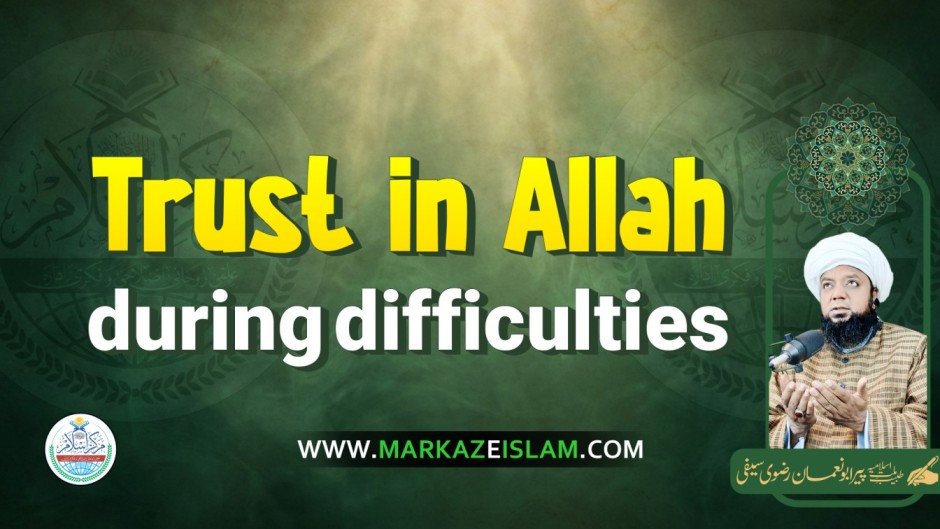
When times turn hostile, circumstances stand defiantly against us, and shadows of despair grow darker all around then the real question is not how big the problem is, but rather whom we trust. Tawakkul ‘ala Allah is not merely a slogan; it is a revolutionary force that turned fire into a garden, the sea into a pathway, and weakness into strength.
Table of Contents
This writing comes to shake us awake to change our supports, revive our conviction, and teach us why and how to place our trust in Allah during hardships.
Tawakkul ‘ala Allah: Why and How Should We Trust Allah in Difficult Times?
Light in Darkness: The Reality and Importance of Tawakkul
Human life is filled with trials sometimes anxiety about sustenance, sometimes fear of illness, sometimes the coldness of loved ones, and sometimes the harshness of circumstances. In such moments, a person knocks first on many doors:
sometimes the doors of means, sometimes of people, and sometimes of one’s own intellect and planning.
But the question is: Does every door open?
And even if it does, does it truly grant peace to the heart?
What Is Tawakkul? Linguistic and Technical Meaning:
The literal meaning of the word “Tawakkul” is to rely on someone other than oneself and to place complete trust in that reliance. That is why, when a person fails to find solutions to his problems on his own, he naturally turns toward a being who has the authority to remove his worries and upon whom he can rely with full certainty and confidence.
Islam guides this natural search in the right direction. It shows us a door that never closes, a support that never weakens, and a connection that remains beneficial in every situation and that is Tawakkul ‘ala Allah.
The Foundation of Tawakkul: Faith in Allah and Belief in His Attribute “Al-Wakeel”
Tawakkul is not merely a word, nor just something uttered by the tongue; rather, it is a firm conviction of the heart that keeps a person connected to Allah even amid the crowd of apparent means. Allah Almighty created us as Muslims and granted us faith that He is perfect in all His attributes. Among these attributes of perfection is the great attribute “Al-Wakeel”the One who sets matters right, rectifies broken situations, and turns the impossible into possible.
When Allah takes responsibility for someone’s affair, He creates solutions from directions a person could never imagine. Fire becoming cool, the sea turning into a path, weakness transforming into strength all of these are shining manifestations of Tawakkul, proclaiming that the true support is neither means nor creation, but the Creator of all means.
This blog draws our attention to the following truths:
What is Tawakkul?
On which foundational beliefs does it stand?
And at what stage does a servant, with full awareness and conviction, become worthy of saying:
“حَسْبِيَ اللہُ وَنِعْمَ الْوَكِيل”
Come, let us try to understand the reality of Tawakkul, its levels, and its spiritual stations in the light of the Holy Qur’an, the lives of the Prophets (peace be upon them), and the sayings of the elders of the Ummah so that our trust does not remain a mere claim, but becomes a living, practical, and effective reality.
The Benefits and Ranks of Tawakkul in the Light of Qur’an and Hadith۔
Allah Is Sufficient for the One Who Trusts Him Tafsir of the Verses:
Allah Almighty created us as Muslims, and we believe that He is perfect in all His attributes. Among His attributes of perfection is “Al-Wakeel”, meaning the One who manages affairs and sets matters right.
If Allah decides to set someone’s affair right, He does so in a way that is beyond human imagination just as Allah saved Prophet Ibrahim (peace be upon him) from the fire, where survival was unimaginable.
Similarly, Allah can resolve our matters and remove our worries as well but for that, we must place complete trust in Allah.
Tawakkul ‘ala Allah The Way of the Prophets (peace be upon them)
The Example of Prophet Ibrahim (peace be upon him)۔
When Sayyiduna Ibrahim Khalilullah (peace be upon him) was placed on the catapult to be thrown into the fire, Jibra’il (peace be upon him) came and said, “Do you need my help?”
Prophet Ibrahim (peace be upon him) placed complete trust in Allah and expressed it with these blessed words:
حَسْبِيَ اللہُ وَنِعْمَ الْوَكِيل
(Surah At-Tawbah, Ayah 129)
Translation: Allah is sufficient for me, and He is the best Disposer of affairs.
Likewise, Allah Almighty revealed to Prophet Dawud (peace be upon him):
“Whoever calls upon Me, I accept his supplication; whoever cries to Me, I respond to his cry; whoever seeks help from Me, I help him; and whoever places trust in Me, I become sufficient for him.”
Allah Almighty says in the Qur’an regarding those who trust Him:
وَ مَنْ يَتَوَكَّلْ عَلَى اللهِ فَهُوَ حَسْبُهُ اِنَّ اللهَ بَالِغُ اَمْرِهِ قَدْ جَعَلَ اللہُ لِكُلِّ شَيْءٍ قَدْرًا
(Surah At-Talaq, Ayah 3)
Translation: And whoever relies upon Allah then He is sufficient for him. Indeed, Allah will accomplish His purpose. Allah has already set for everything a measure.
In the explanation of this verse, Hazrat Rabi‘ bin Khuthaym (رحمہ اللہ) says:
Allah becomes sufficient for such a person against everything that causes hardship for people.
Mufti Muhammad Shafi‘ (رحمہ اللہ) writes:
“Whoever places trust in Allah, Allah is sufficient for his difficulties, because Allah completes His affairs in the way He wills. He has fixed a measure for everything, according to which all matters occur.”
When Hardship Strikes
Imam Ibn Abi al-Dunya narrates that the Beloved Prophet ﷺ said:
When a servant faces grief or calamity, he should recite:
حَسْبِيَ الرَّبُّ مِنَ الْعِبَادِ، حَسْبِيَ الخَالِقُ مِنَ المَخْلُوقِينَ، حَسْبِيَ الرَّازِقُ مِنَ المَرْزُوْقِيْنَ، حَسْبِيَ الَّذِي هُوَ حَسْبِيْ، حَسْبِيَ اللهُ وَنِعْمَ الْوَكِيلُ، حَسْبِيَ الله ُلَا اِلٰهَ اِلَّا هُوَ عَلَيْهِ تَوَكَّلْتُ وَهُوَ رَبُّ الْعَرْشِ الْعَظِيمِ
Translation: Instead of servants, my Lord is sufficient for me; instead of creation, my Creator is sufficient for me; instead of means of sustenance, my Provider is sufficient for me; Allah is sufficient for me—He is the best Disposer of affairs. There is no deity except Him; upon Him I rely, and He is the Lord of the Mighty Throne.
(Reference: موسوعہ ابن ابی دنیا، الفرج بعد الشدة، Vol. 2, p.114, Hadith 54)
The Reality of Tawakkul
Allah Almighty says:
حَسْبُنَا اللہُ وَنِعْمَ الْوَكِيل
(Surah Aal-e-Imran, Ayah 173)
Translation: Allah is sufficient for us, and He is the best Disposer of affairs.
The Four Levels of Tawhid Foundations of Tawakkul
Tawakkul is a fruit of faith, and faith has many aspects. Among these, two are the foundation of Tawakkul:
۔1Beliefin Tawhid (Oneness of Allah)
۔2Belief in Allah’s perfection and mercy
The explanation of Tawhid is extensive, and its knowledge reaches the pinnacle of the sciences. However, we will only present that much which forms the foundation of Tawakkul. Tawhid has four levels, with one core, and that core itself has another core. There is also a peel, and the peel itself has another peel. Thus, there are two cores and two peels of Tawhid. Its example is like a raw walnut: it has two outer shells and one core visible, while its oil is the essence of the inner core.
Level 1 (Core): Verbal declaration and imitative belief – Saying La ilaha illallah and holding belief as common people do, based on a single proof.
Level 2 (Core of the Core): Heartfelt belief based on reasoning Believing in the meaning of the Kalima deeply through reflection.
Level 3 (Peel of the Core): Through observation, one sees that the essence of all is One, and there is no actor greater than One. There is no other actor, and this is a light that is generated within the heart. From this light, this observation is attained. It is not like the beliefs of the common people (‘Awam al-Naas’) or the theologians (‘Mutakallim’), because their belief is a knot that is tied to the heart through imitation or reasoning. True observation opens the heart, removes all knots, and breaks all constraints..
Example:
The imitation of the common people (‘Awam al-Naas’) is like a person who believes in causes, thinking: “So-and-so is at home because of such-and-such reason,” or following what he heard from his parents. The example of the belief of the theologians (‘Mutakallim’) is like a person who sees a horse and a servant at the door and infers, “Such-and-such person must be at home,” based on reasoning and deduction.
The example of the unity of the ‘Aarif’ (the gnostic) is someone who directly observes. Although this level of Tawheed is high, the Aarif at this stage perceives both the Creator and the creation. He knows that the creation has appeared from the Creator. Therefore, in this level of Tawheed, multiplicity is still present, and as long as the Aarif observes the two (Creator and creation), there remains a sense of separation, not unity. This is not yet the perfection of Tawheed.
Level 4 (Peel of the Peel): Except for One, he sees nothing else, and observes everything as One, understanding everything as a single reality. In this observation, no multiplicity or distinction enters. The pious Sufis call this stage Fana-fi-Tawheed (annihilation in the Unity of God).
It is narrated that Hazrat Hussain ibn Mansur al-Hallaj, may Allah have mercy on him, saw a revered mystic (Hazrat Khawas, may Allah have mercy on him) crying alone in the wilderness. He asked: “What are you doing?” The mystic replied: “I am aligning my steps in reliance (Tawakkul) on Allah.” Hazrat Hussain ibn Mansur al-Hallaj, may Allah have mercy on him, said: “You have spent your life immersed in the inner realm; from nothingness, when will you reach the station of Tawheed?”
Stations of Tawheed: The Tawheed of the Hypocrite, the Common People, the Theologian, and the Gnostic۔
There are four stations of Tawheed, which are as follows:
Tawheed of the Hypocrite:
This is like the outer shell of a walnut. The outer shell may appear green and firm, but when observed from the inside, it is unpleasant. If it is burned, it produces smoke and extinguishes fire, and if kept aside, it serves no practical purpose except occupying space. Its only function is to preserve the inner shell for a few days so that it remains fresh and protected from harm. Similarly, the Tawheed of the hypocrite is of no real use. It only protects the hypocrite’s “body” (the outward self) from the sword. The hypocrite may escape worldly harm due to a verbal declaration of Tawheed, but once the body perishes and only the soul remains, this kind of Tawheed proves to be of no benefit just as the outer shell of a walnut cannot serve the inner kernel. The outer shell only exists to safeguard the kernel, but compared to the kernel, it is trivial and insignificant.
Tawheed of the Common People and the Theologians۔
Similarly, the Tawheed of the common people (Aam) and the theologians (Mutakallim) serves to protect the “kernel,” meaning the soul, from the fire of Hell. Although this level of Tawheed fulfills this protective function, it lacks the subtlety and essence of the kernel and oil (the core spiritual reality). Just as the kernel of a walnut is precious, but when compared to the oil inside, the shell is merely a burden with no inherent perfection. This station of Tawheed, too, is not free from multiplicity, division, or excess.
Tawheed of the Gnostic (Arif)۔
The highest and purified station of Tawheed is the fourth station, which belongs to the Gnostic (Arif). In this station, only the Truth remains as Truth. The Gnostic sees nothing besides the One, forgets himself, and as other things vanish from his sight, he too becomes nonexistent in his own perception. In other words, even his own existence becomes imperceptible to him, as he observes nothing but the One Reality.
Tawakkul: The Strong Staff That Makes the Impossible Possible:
In the dense forests of hardship, where despair is scattered at every step and all doors of means appear closed, Tawakkul upon Allah is the strong staff that not only shows the way but also ensures reaching the destination. This is not just a concept; it has been the practical approach of the Prophets and Awliya, through which they turned impossibilities into realities.
Tawakkul requires that every action, thought, and hope be subject to the certainty:
حَسْبِيَ اللہُ وَنِعْمَ الْوَكِيل
When a servant acknowledges their weakness and stretches their hands of need before the Creator, Allah opens ways unseen in human imagination.
Our faith is that Allah’s attribute Al-Wakeel is the solution to every problem, the remedy for every difficulty, and the promise of ease after hardship. Tawakkul asks us to use means but not rely on them; to strive, yet leave the outcome to Allah; to pray, and patiently await His decree.
Remember, Tawakkul is the essence of faith, and whoever places trust in Allah, Allah becomes sufficient for them. Through this trust, our predecessors achieved great feats that became part of history. Today, if we ignite the lamp of Tawakkul in our hearts, darkness will vanish, difficulties will ease, and life’s crises will turn into smooth paths.
May Allah grant us understanding of Tawakkul’s reality and the ability to fully implement it in our lives. Ameen, Thumma Ameen.
✍️ Written by: Sultan al-Waza’if, Tabeeb-e-Millat, Hazrat Sarkar Peer Abu Numan Rizvi Saifi
(Reference: Bahar-e-Saifiya, Part 3)