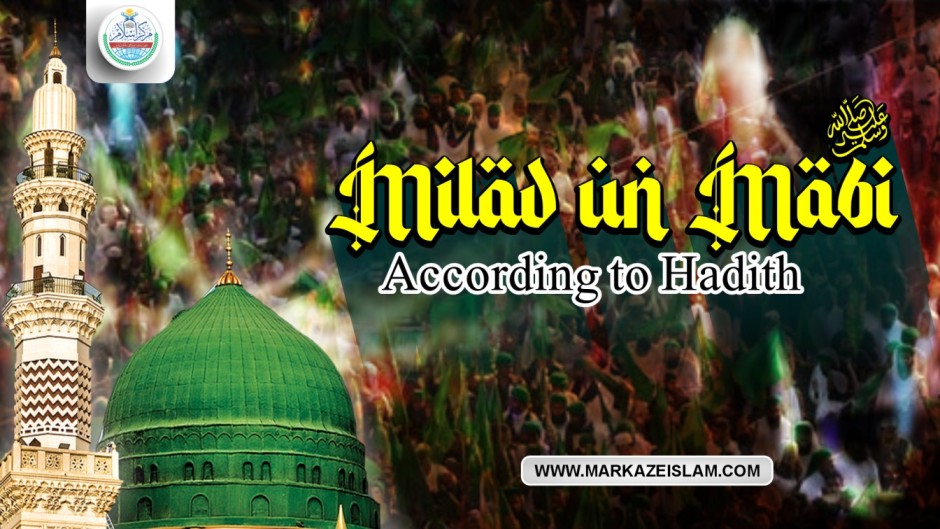
This is the mention and expression of gratitude for that great blessing through which Allah Almighty, by means of His beloved Prophet Muhammad (ﷺ), Himself introduced the religion of Islam. This is that blessing for which no amount of gratitude would ever be enough. The blessed birth of the Prophet (ﷺ) is nothing less than a miracle, for it is through this that we received the religion of Islam, the Holy Qur’an, and the recognition of the Lord, the Most Merciful. This is purely a story of love.
Table of Contents
If we reflect, Allah Almighty prescribed duties for Himself, but for His Beloved (ﷺ), He kept only love. As stated in the Qur’an:
إِنَّ ٱللَّهَ وَمَلَـٰٓئِكَتَهُۥ يُصَلُّونَ عَلَى ٱلنَّبِىِّ ۚ يَـٰٓأَيُّهَا ٱلَّذِينَ ءَامَنُوا۟ صَلُّوا۟ عَلَيْهِ وَسَلِّمُوا۟ تَسْلِيمًا
“Indeed, Allah and His angels send blessings upon the Prophet. O you who believe, send blessings and peace upon him in abundance.”
Here lies a subtle point: The Lord of the worlds did not use the general word “Muslims,” but instead said “those who believe.” In other words, the address is to those lovers who have truly brought faith and whose hearts are filled with the love of Mustafa (ﷺ).
In our previous blog, we presented a collection of verses from the Holy Qur’an that establish the legitimacy of celebrating the birth of the Prophet (ﷺ).
Now, in this blog, we will, in the light of the Prophetic traditions, study how the Noble Prophet (ﷺ) himself mentioned and expressed gratitude for his birth, and how he taught the Companions (may Allah be pleased with them) the manner in which the birth day of a Prophet is to be observed.
Hadith No. 1
It is narrated from Hazrat Ibn Abbas (may Allah be pleased with him) that when the Messenger of Allah (ﷺ) arrived in Madinah Munawwarah, he saw the Jews observing a fast on the Day of Ashura. The Prophet (ﷺ) inquired, “What is this (fast)?” The Jews replied, “This is the blessed day on which Allah Almighty granted deliverance to Bani Israel from their enemy (Pharaoh). Therefore, Hazrat Musa (peace be upon him) observed a fast on this day.” The Prophet (ﷺ) said, “I am closer to Musa (peace be upon him) than you.” Thus, the Prophet (ﷺ) himself observed the fast on that day and commanded the Muslims to also observe the fast.
References: Sahih al-Bukhari, vol. 2, p. 704, Kitab al-Sawm – Sawm Yawm ‘Ashura; Musnad Ahmad, vol. 1, p. 291; Musnad Abu Ya’la al-Mawsili, vol. 4, p. 441.
This same hadith is also narrated from Ibn Abbas (may Allah be pleased with him) with slight variation in wording in Sahih al-Bukhari, Kitab al-Manaqib, Bab Ityan al-Yahud al-Nabi Hina Qadim al-Madinah. The same hadith, with similar wording, is also found in Sahih Muslim, vol. 2, p. 795, Kitab al-Sawm; Abu Dawud, vol. 2, p. 326; and has been recorded by Ibn ‘Abd al-Barr in al-Tamhid lima fi al-Muwatta min al-Ma’ani wa al-Asanid, vol. 7, p. 209.
This noble hadith clearly indicates that the day upon which Allah Almighty bestows a blessing should be commemorated as a remembrance. The Jews commemorated the day upon which mercy was granted exclusively to them, and the Prophet (ﷺ) did not prohibit them from doing so. In fact, he himself observed the fast and instructed his Companions (may Allah be pleased with them all) to do likewise. However, the day of the birth of the Prophet Muhammad (ﷺ) is the greatest of days, for on this day Allah Almighty bestowed His grace and mercy upon the entire universe. Therefore, the day of his blessed birth is even more deserving of being commemorated as a remembrance.
Hadith No. 2
Hazrat Abu Musa Ash‘ari (RA) narrates that the Jews used to venerate the Day of ‘Ashura
وَتَتَّخِذَهُ عَبْدًا، فَقَالَ رَسُولُ اللَّهِ ﷺ صُومُوا أَنْتُمْ:
“…and they would treat it as a day of Eid. So the Messenger of Allah ﷺ said: ‘You should fast on this day.’”
(Sahih Muslim, vol. 2, p. 796, Kitab al-Siyam – Sahih al-Bukhari, vol. 2, p. 704, Kitab al-Siyam – Sharh Ma‘ani al-Athar by al-Tahawi, vol. 2, p. 76)
This Hadith clearly shows that on the day when mercy was shown exclusively to one nation, that nation celebrated it as a day of Eid. The Beloved Prophet ﷺ did not forbid them from this, but in fact, he himself observed fasting on that day and also instructed the Companions (RA) to fast on it.
Therefore, the day when mercy for all the worlds was sent to creation is undoubtedly even more deserving of being celebrated as a day of Eid. However, it must be remembered that calling the Eid Milad-un-Nabi ﷺ an “Eid” is only in the linguistic sense—meaning joy, happiness, and celebration—not in the legal (Shar‘i) sense of the term “Eid.”
Hadith No. 3
It is narrated from Hazrat Abu Hurairah (RA) that when the Messenger of Islam (ﷺ) inquired from the Jews about fasting, they replied: “On this day, the Ark came to rest upon Mount Judi, and on this day, both Prophet Nuh (AS) and Prophet Musa (AS) observed a fast out of gratitude to Allah Almighty.”
The Noble Prophet (ﷺ) then said: “I have a greater right to Musa (AS) than anyone else, and I am more entitled to observe a fast on this day.” Thereupon, the Prophet (ﷺ) instructed his Companions to fast on that day.
Reference: Musnad Imam Ahmad, vol. 2, p. 359; Fath al-Bari, vol. 4, p. 247.
If the Day of Nuh (AS) and the Day of Musa (AS) can be commemorated, then the commemoration of the Mawlid (Birth) of the Prophet Muhammad ﷺ is even more deserving and appropriate.
Hadith No. 4
It is narrated from Hazrat Abu Qatadah Ansari (RA) that the Messenger of Allah ﷺ was asked about fasting on Mondays. The Noble Prophet ﷺ replied:
ذَاكَ يَوْمٌ وُلِدْتُ فِيهِ، وَيَوْمٌ بُعِثْتُ أَوْ أُنْزِلَ عَلَيَّ فِيهِ
“That is the day on which I was born, and the day on which I was sent (as a Prophet), or the day on which revelation was sent down to me.”
References: Sahih Muslim Sharif, vol. 2, p. 819, Kitab al-Siyam; Sunan al-Kubra al-Bayhaqi, vol. 4, p. 286; Sunan al-Kubra al-Nasa’i, vol. 2, p. 146; Musnad Imam Ahmad, vol. 5, p. 296; Musannaf ‘Abd al-Razzaq, vol. 4, p. 296.
Thus, on this very day was my blessed birth, on this very day was my Prophethood, and on this very day the Qur’an was revealed to me.
This noble and authentic Hadith is explicit in its indication that expressing joy on the Day of the Birth of the Prophet ﷺ is from the blessed practice of the Prophet ﷺ himself.
Hadith No. 5
Hazrat Ka‘b al-Ahbar (RA) said to Hazrat ‘Umar al-Farooq (RA): “I know of a people that if this verse had been revealed to them, they would have awaited that day and celebrated it as an Eid.”
Hazrat ‘Umar al-Farooq (RA) asked: “Which verse?”
Ka‘b al-Ahbar (RA) replied:
ٱلۡيَوۡمَ أَكۡمَلۡتُ لَكُمۡ دِينَكُمۡ وَأَتۡمَمۡتُ عَلَيۡكُمۡ نِعۡمَتِي وَرَضِيتُ لَكُمُ ٱلۡإِسۡلَٰمَ دِينٗا
“This day I have perfected for you your religion, and completed My favor upon you, and have chosen for you Islam as your religion.”
Hazrat ‘Umar (RA) said: “I know on which day this verse was revealed — it was on a Friday, and the Day of ‘Arafah, and both of these are our Eid days.”
References: Al-Mu‘jam al-Awsat by al-Tabarani, vol. 1, p. 253; Fath al-Bari, vol. 1, p. 105; Tafsir Ibn Kathir, vol. 2, p. 14.
If the day on which the verse of perfection of the religion was revealed to the Prophet ﷺ is to be celebrated as an Eid, then how much more deserving is that the day on which the Master of the Worlds, Muhammad, the Messenger of Allah ﷺ, himself came into this world should be celebrated as an Eid.
Hadith No. 6
It is narrated from Hazrat Abdullah ibn Abbas (RA) that the Holy Prophet ﷺ said regarding the blessed Friday:
“إِنَّ هَذَا يَوْمُ عِيدٍ جَعَلَهُ اللَّهُ لِلْمُسْلِمِينَ“
“Indeed, this is a day of Eid which Allah Almighty has made for the Muslims.”
(Ibn Majah, Kitab Iqamat al-Salat, Bab fi al-Zinah Yawm al-Jumu‘ah, Hadith No. 1098, Vol. 1, p. 349. Al-Mu‘jam al-Awsat by Tabarani, Vol. 7, p. 230, Hadith No. 7355)
In several Ahadith, it has been stated that on the day of Jumu‘ah, send abundant blessings (Durood) upon me. This is the most virtuous of your days. On this day, Hazrat Adam (AS) was created, on this day his soul was taken, on this day the Trumpet will be blown, and on this day send abundant salutations upon me.
(Sunan Abi Dawood, Vol. 1, p. 275; Sunan al-Nasa’i, Vol. 1, p. 519; Ibn Majah, Vol. 1, p. 359)
So, the day on which Hazrat Adam (AS) was created, i.e., the day of Jumu‘ah, is considered a day of Eid. Then why can the day on which the Leader of all Prophets, the Mercy for all the worlds, Sayyid al-‘Alameen, Muhammad Rasul Allah ﷺ was born, not also be celebrated as a day of Eid?
Hadith No. 7
It is narrated from Hazrat Anas bin Malik (RA) that:
“The Prophet (ﷺ) performed ‘Aqeeqah for himself after the declaration of his Prophethood.”
(Al-Ahadeeth Al-Mukhtaar, vol. 5, p. 205; Al-Mu‘jam Al-Awsat by Tabarani, vol. 1, p. 298; Mand Rawayani, vol. 2, p. 386; Sunan Al-Kubra by Bayhaqi, vol. 9, p. 300)
Regarding this Hadith, Allama Jalaluddin Suyuti (رحمه الله) states:
‘Aqeeqah is not performed twice, because on the seventh day after the blessed birth of the Prophet (ﷺ), his noble grandfather Abdul Muttalib (RA) had already performed it. Therefore, the reason for the Prophet (ﷺ) performing ‘Aqeeqah himself after the declaration of Prophethood could be that he did so to express joy over his blessed birth, due to his being “Rahmatul-lil-‘Aalameen” (Mercy for all worlds) and because of the honour granted to the Ummah through him.
In the same way, it is recommended for us to express happiness on the blessed day of the Prophet’s (ﷺ) birth — by feeding others, engaging in acts of worship, and manifesting joy.
(Al-Haawi lil-Fataawa, p. 196; Hujjatullah ‘Ala Al-‘Aalameen, p. 237)
This informative and spiritual blog is the result of the compilation and writing of Hazrat Pir Abu Nauman Rizvi Saifi Sahib, who, with sincerity and devotion, continues to guide the Muslim Ummah in matters of religion and spirituality. If you have found this article beneficial and enlightening, then kindly express your valuable opinion regarding it, and share it with your friends, family, and other acquaintances so that this message may reach as many hearts as possible. If you wish for this series of blog posts to continue, then please let us know your opinion in the comment box below.