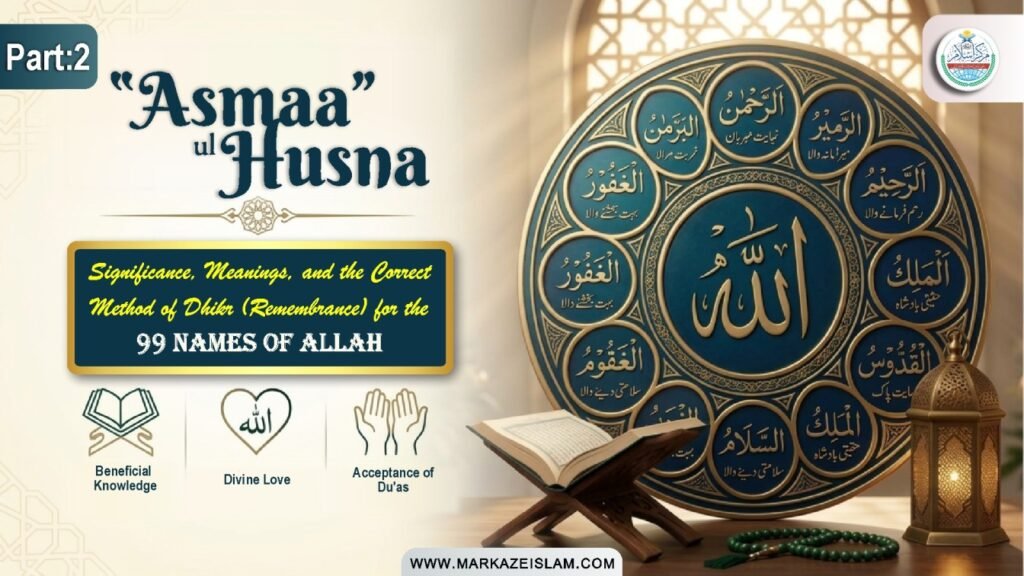
The Virtue of Allah’s 99 Names, Their Meanings, and the Correct Method of Dhikr
In [Part One – link], we covered the introduction to Asma-ul-Husna, the Qur’anic command, the hadith of the 99 Names, the three levels of “ihsa’” (enumeration), the Greatest Name (Ism-e-A’zam), and the etiquette of dhikr. We also covered the Names from Ar-Rahman up to Al-Ba’ith, along with their accepted practices (ma’mulat).
Table of Contents
In this part we will discuss three questions that are asked most often: how supplications are accepted through the Names, how love of Allah is created in the heart through them, and how beneficial knowledge is connected to them. At the end are the remaining Names from Ash-Shahid to As-Sabur, with their accepted practices.
Before beginning, remember one thing: without sincerity, durood (salutations upon the Prophet ﷺ), and humility, reciting a Name is merely repeating words. We have already explained this in detail in “Etiquette of Du’a.”
Jalali and Jamali Names: Two Groups of Allah’s Names
Scholars have described two broad groups to help us understand Allah’s Names.
- Jamali Names: those containing mercy, love, and tenderness, such as Ar-Rahman, Ar-Rahim, Al-Wadud, Ar-Ra’uf, Al-Barr, Al-‘Afuww.
- Jalali Names: those in which majesty, power, and dominance are evident, such as Al-Qahhar, Al-Jabbar, Al-Mutakabbir, Al-Muntaqim, Al-Qawiyy.
This division teaches us that both groups are attributes of Allah’s perfection. One who remembers Allah’s mercy should not forget His majesty, and one who remembers His majesty should not despair of His mercy. Correct faith lies between fear and hope. Therefore, even when supplicating with the Jalali Names, the intention should never be to harm anyone; rather, it should be to seek one’s own protection and to acknowledge Allah’s greatness.
The Acceptance of Du’as and Allah’s Names

The greatest source of comfort for one who makes du’a is this Qur’anic verse:
وَإِذَا سَأَلَكَ عِبَادِي عَنِّي فَإِنِّي قَرِيبٌ ۖ أُجِيبُ دَعْوَةَ الدَّاعِ إِذَا دَعَانِ (Al-Baqarah: 186)
Translation: And when My servants ask you about Me, [tell them] I am near. I answer the call of the caller when he calls upon Me.
This verse tells us that no intermediary is needed to call upon Allah. Supplicating with the Names means that the servant, according to his need, calls upon a particular attribute of Allah, such as Ar-Razzaq in matters of sustenance and Al-Ghaffar in matters of forgiveness. This method is also part of the etiquette of du’a: first praise and glorification of Allah, then durood, then one’s need.
The Prophet’s ﷺ Du’a for Grief and Distress
It is narrated from Abdullah ibn Mas’ud (may Allah be pleased with him) that the Prophet ﷺ said: whoever is afflicted by grief or distress and makes this du’a, Allah removes his grief and replaces it with ease.
اللَّهُمَّ إِنِّي عَبْدُكَ، ابْنُ عَبْدِكَ، ابْنُ أَمَتِكَ، نَاصِيَتِي بِيَدِكَ، مَاضٍ فِيَّ حُكْمُكَ، عَدْلٌ فِيَّ قَضَاؤُكَ، أَسْأَلُكَ بِكُلِّ اسْمٍ هُوَ لَكَ، سَمَّيْتَ بِهِ نَفْسَكَ، أَوْ عَلَّمْتَهُ أَحَدًا مِنْ خَلْقِكَ، أَوْ أَنْزَلْتَهُ فِي كِتَابِكَ، أَوِ اسْتَأْثَرْتَ بِهِ فِي عِلْمِ الْغَيْبِ عِنْدَكَ، أَنْ تَجْعَلَ الْقُرْآنَ رَبِيعَ قَلْبِي، وَنُورَ صَدْرِي، وَجَلَاءَ حُزْنِي، وَذَهَابَ هَمِّي (Musnad Ahmad)
Translation: O Allah! I am Your servant, the son of Your servant, the son of Your maidservant. My forelock is in Your hand. Your command concerning me is effective, and Your decree concerning me is just. I ask You by every name that is Yours, by which You have named Yourself, or taught to any of Your creation, or revealed in Your Book, or kept with Yourself in the knowledge of the unseen: make the Qur’an the spring of my heart, the light of my chest, the removal of my grief, and the end of my distress.
The words “bi-kulli ismin” (by every name) in this du’a are also evidence for what we wrote in Part One: that Allah’s Names are not limited to 99.
Hold Fast to “Ya Dhal-Jalali wal-Ikram”

The Prophet ﷺ said: hold fast to “Ya Dhal-Jalali wal-Ikram” (Musnad Ahmad).
That is, keep calling out “Ya Dhal-Jalali wal-Ikram” again and again. From this we learn that calling upon one Name repeatedly, pausing with it and with the heart fully engaged, is the sunnah (masnun) method of du’a.
What If the Du’a Does Not Appear to Be Accepted?
According to the Prophet’s ﷺ teaching (Musnad Ahmad): when a Muslim makes a du’a that contains no sin and no severing of family ties, Allah grants him one of three things: either what he asked for is given to him; or in its place some evil is turned away from him; or its reward is stored up for him in the Hereafter. Therefore, do not be hasty in reciting the Names as a wird.
If a need is fulfilled after the du’a, we have already mentioned in Part One that one should recite: “الْحَمْدُ لِلَّهِ الَّذِي بِعِزَّتِهِ وَجَلَالِهِ تَتِمُّ الصَّالِحَاتُ” (“All praise is for Allah, by whose honor and majesty good things are completed”). Among the du’as for protection, also recite Ayat al-Kursi, in which “Al-Hayy, Al-Qayyum” is mentioned.
Divine Love: Al-Wali, Al-Wadud, Ar-Ra’uf, Al-Barr

The second theme of the Names is the love of Allah. The Qur’an contains many Names that express Allah’s love and closeness:
وَهُوَ الْغَفُورُ الْوَدُودُ (Al-Buruj: 14) —
“And He is the Forgiving, the Loving.”
وَهُوَ الْوَلِيُّ الْحَمِيدُ (Ash-Shura: 28) —
“And He is the Protecting Friend, the Praiseworthy.”
إِنَّ اللَّهَ بِالنَّاسِ لَرَءُوفٌ رَّحِيمٌ (Al-Baqarah: 143) —
“Indeed, Allah is Kind and Merciful to people.”
“Al-Wali” means friend and helper. Allah says:
اللَّهُ وَلِيُّ الَّذِينَ آمَنُوا يُخْرِجُهُم مِّنَ الظُّلُمَاتِ إِلَى النُّورِ (Al-Baqarah: 257)
That is, Allah is the Friend of the believers; He brings them out of the darknesses into the light.
Attaining the love of Allah does not come merely from taking His Names with the tongue; it comes from walking according to what they demand. One who recites “Ar-Ra’uf” should also learn tenderness toward his family and those under his care.
Beneficial Knowledge: Al-Hadi, An-Nur, Ar-Rashid
The third theme is knowledge and guidance. The Qur’an says:
وَكَفَىٰ بِرَبِّكَ هَادِيًا وَنَصِيرًا (Al-Furqan: 31) —
“And your Lord suffices as a guide and helper.”
اللَّهُ نُورُ السَّمَاوَاتِ وَالْأَرْضِ (An-Nur: 35) —
“Allah is the Light of the heavens and the earth.”
“Al-Hadi” is the one who gives guidance, “An-Nur” is the light, and “Ar-Rashid” is the one who shows the right path. Therefore, when someone asks for knowledge, understanding, or comprehension, supplicating with these Names is very fitting. However, the real means of beneficial knowledge is reading, understanding, and acting. The wird of the Names is not a substitute for this; it is a helper. When one cannot find the way in an important decision, the sunnah is to make istikhara, the method of which we have explained in “How to Perform Istikhara.”
What the Names Demand in Everyday Life
The wird of a Name gives its full benefit when the corresponding attribute is also visible in one’s life. Below are some points for reflection. (These are not hadith; they are a suggested sequence for contemplation.)
| Blessed Name | Point for Reflection | Practical Demand |
| Ash-Shahid | Allah is a witness in every situation | Avoid sin even in solitude; speak the truth |
| As-Sabur | He is very forbearing | Patience in hardship; avoid haste |
| Ar-Ra’uf | He is very kind | Gentleness in anger |
| At-Tawwab, Al-‘Afuww | He accepts repentance and pardons | Do not delay repentance; forgive others |
| Al-Ghani | He is free of all need | Contentment; reduce expectations from creation |
| Al-Baqi, Al-Warith | He is the One who remains | Do not become arrogant over worldly wealth |
| Al-Hadi, Ar-Rashid | He shows the way | Consultation, istikhara, seeking knowledge |
Regarding the Names related to sustenance (rizq), we have previously explained them in “The Wazifa for Blessing in Sustenance” and “What Is the Reality of Tawakkul?” Read both together with these demands.
Etiquette of Paired Names
Some of the Names of Allah appear alongside a Name of opposite meaning:
- Al-Qabid and Al-Basit (the Withholder and the Expander)
- Al-Khafid and Ar-Rafi’ (the Lowerer and the Raiser)
- Al-Mu’izz and Al-Mudhill (the Giver of honor and the Giver of humiliation)
- Al-Muqaddim and Al-Mu’akhkhir (the One who brings forward and the One who puts back)
- Ad-Darr and An-Nafi’ (the Inflicter of harm and the Giver of benefit)
- Al-Mubdi’ and Al-Mu’id (the Originator and the Restorer)
Many scholars hold that such a Name should not be recited alone but together with its counterpart, because the perfection lies in the two combined. So if you wish to recite “Ad-Darr,” say “Ad-Darr, An-Nafi’,” and pair “Al-Mudhill” with “Al-Mu’izz.” Keep this in mind in this part and in the accepted practices listed in the tables.
From Ash-Shahid to As-Sabur: Benefits of the Asma-ul-Husna

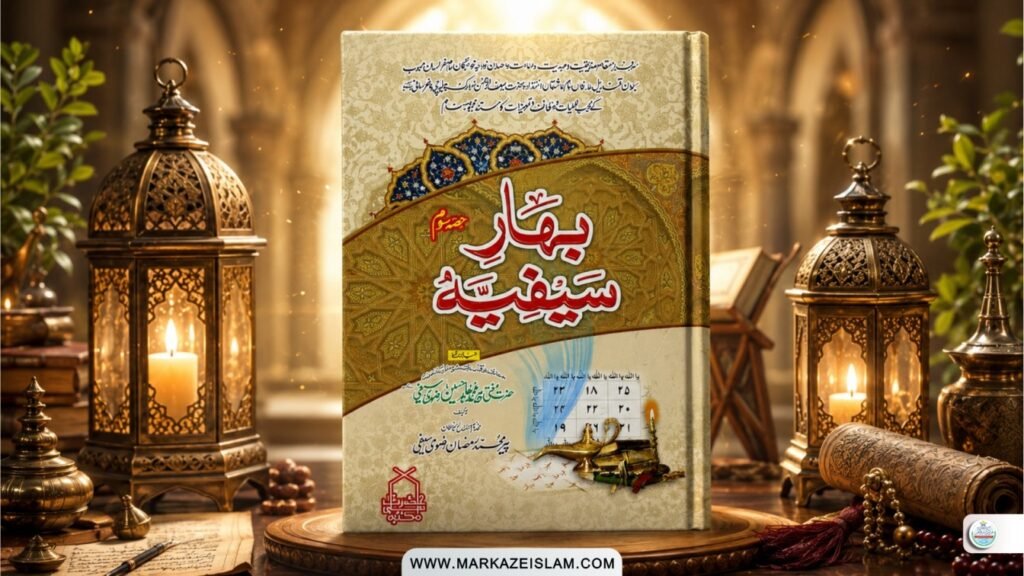
The practices following this are mentioned in the book [Bahari Saifia] (Part Three). Like those in Part One, these are also the experiences of our elders. They are not commands of the Qur’an or hadith, so they should not be considered religiously obligatory. Reciting durood sharif at the beginning and end of every practice is also part of its etiquette, and it is better to begin any practice under the guidance of a scholar.
| Blessed Name | Meaning | Objective | Accepted Practice |
| Al-Wakil | Disposer of affairs (Trustee) | Help in every need | Abundant dhikr |
| Al-Qawiyy | Possessor of great strength | Removal of faint-heartedness; creation of courage | Abundant dhikr |
| Al-Wali | Friend and Helper | Allah’s friendship; ease in difficulty | Abundant dhikr; 1,000 times on Shab-e-Jumu’ah in times of difficulty |
| Al-Hamid | Worthy of praise | Good character and good speech | Abundant dhikr |
| Al-Mu’id | The One who restores | To recall something forgotten | Repeatedly if something is forgotten (together with Al-Mubdi’) |
| Al-Muhyi | Giver of life | For fear of separation or imprisonment | Abundant dhikr |
| Al-Mumit | Giver of death | Reform of extravagance and of the rebelliousness of the self (nafs) | Abundant dhikr |
| Al-Qayyum | Sustainer of all | Steadfastness in worship | “Ya Hayyu Ya Qayyum” from Fajr until sunrise |
| Al-Wajid | Finder of everything | Strengthening of the heart | Recite on each morsel before eating |
| Al-Majid | Possessor of glory | Constant light of the heart | Abundant dhikr, always |
| Al-Wahid | The One, Unique | To reduce the heart’s attachment to anything other than Allah | 1,000 times |
| As-Samad | Free of all need | Signs of sincerity and devotion | 125 times in the last part of the night |
| Al-Qadir | Possessor of power | Strength and resolve | 100 times after two rak’ahs of prayer |
| Al-Muqtadir | Possessor of full authority | Ease in arranging one’s intended affairs | Abundantly, after rising from sleep |
| Al-Mu’akhkhir | The One who puts back | Repentance from evil deeds | Abundant dhikr |
| Al-Awwal | The First | A quick meeting with one’s family | For a traveler, 1,000 times every Friday |
| Al-Akhir | The Last | Purification of the heart from thoughts of anything other than Allah | 1,000 times daily |
| Az-Zahir | The Manifest | Light and illumination in the heart | Abundantly, at the time of Ishraq |
| Al-Batin | The Hidden | The state of the hidden breath | Three times daily, up to one hour |
| Al-Muta’ali | Exalted and Most High | Elevation and correctness | Abundant dhikr |
| Al-Barr | The Doer of good | Good fortune of a child | Recite seven times and blow on the child |
| At-Tawwab | Acceptor of repentance | Being granted the ability to repent | 360 times after Chasht prayer |
| Al-‘Afuww | The Pardoner | Forgiveness of sins; Allah’s pleasure | Abundant dhikr |
| Ar-Ra’uf | Extremely Compassionate | Calm at the time of anger | 10 times at the time of anger, and 10 times durood |
| Malik-ul-Mulk | Owner of sovereignty | Removal of severe poverty/hardship | 1,100 times daily |
| Dhul-Jalali wal-Ikram | Possessor of Majesty and Honor | Honor and greatness | Abundant dhikr |
| Al-Muqsit | The Equitable | Protection from whisperings (waswasa) in worship | Continuously |
| Al-Jami’ | The Gatherer | Focus (single-mindedness) on goals; recovering a lost item | Continuously |
| Al-Mughni | The Enricher | Prosperity | 1,000 times |
| An-Nafi’, Ad-Darr | The Giver of benefit / the Inflicter of harm | Protection from harm; seeking benefit | 100 times on Shab-e-Jumu’ah (both together) |
| An-Nur | The Light | Light of the heart | Abundant dhikr |
| Al-Hadi | The Guide | Correct insight and understanding | Abundant dhikr |
| Al-Badi’ | The Incomparable Originator | Fulfillment of a need | 1,000 times |
| Al-Baqi | The Everlasting | Deliverance from grief and harm | 1,000 times |
| Al-Warith | The Inheritor of all | Removal of bewilderment | 1,000 times between Maghrib and Isha |
| Ar-Rashid | The One who guides | Acceptance of deeds | 100 times after Isha prayer |
| As-Sabur | Extremely Patient | Protection from heavy hardship | 100 times before sunrise |
Common Mistakes to Avoid
Besides the mistakes mentioned in Part One, remember two more things:
- Do not use the Jalali Names against others. Reciting Al-Qahhar, Al-Muntaqim, or Al-Jabbar with the intention of harming someone goes against the purpose of the Names. Keep the intention of seeking your own protection and relying on Allah.
- Do not take any single Name as the “solution to every problem.” The whole collection of the Names is a path of connection with Allah; no single Name is key of all problems.
Frequently Asked Questions (FAQ)
Is it wrong to recite a Jalali Name (like Al-Qahhar or Al-Muntaqim)?
No. These are also among Allah’s beautiful Names, but one must keep the intention of respect and protection, and it is better to recite paired Names together.
Can one do dhikr of the Names without a shaykh’s permission?
General dhikr and du’a with Allah’s Names can be done by any Muslim. However, regarding practices with large counts that are mentioned in books, our spiritual elders (mashaikh) advise beginning them under the guidance of a scholar.
Can the Names be written down and kept, or recited over water and drunk?
This is a matter of disagreement among scholars. Some permit amulets (ta’widh) containing Allah’s Names and Qur’anic verses under certain conditions, and some forbid them. The fundamental condition is that any effect be understood as coming from Allah, and that neither the ta’widh nor the Name itself be considered effective on its own.
What if the need does not seem to be fulfilled despite the wird?
Du’a is accepted in several ways, as explained above. Keep up the wird, take worldly means as well, and trust Allah’s decision.
Is the wird of the Names enough in illness?
No. Along with the wird and du’a, proper medical treatment is necessary.
Conclusion
In Part One we learned the recognition of the Names and their etiquette, and Part Two takes us through them toward du’a, divine love, and beneficial knowledge. Accept both groups, Jalali and Jamali; observe the etiquette of paired Names; and try to bring every wird into your practice.
O Allah! Grant us the ability to ask You by Your Names, to know You, and to love You. Ameen.
For More Detail
The book [title unclear] (Part Three) contains further special properties of the Names, their accepted practices, and their order. It is a collection of tried practices and wazaif (litanies) of Hazrat Faiz-ur-Rahman Mubarak, compiled by Peer Muhammad Ramzan Rawzi Faizi. The book is not available in every shop; it is supplied through selected bookstores, and it can now also be ordered online.
→ Order the book online [link]
The Complete List of the 99 Names (Expandable Table)
This is the well-known list that is commonly circulated on the basis of Tirmidhi’s narration. As explained in Part One, there are slight differences among the various lists, and the number of Names is not limited to 99.
| # | Arabic | Transliteration | Meaning |
| 1 | الرَّحْمَنُ | Ar-Rahman | Most Compassionate |
| 2 | الرَّحِيمُ | Ar-Rahim | Extremely Merciful |
| 3 | الْمَلِكُ | Al-Malik | The King |
| 4 | الْقُدُّوسُ | Al-Quddus | Utterly Pure |
| 5 | السَّلَامُ | As-Salam | Giver of peace |
| 6 | الْمُؤْمِنُ | Al-Mu’min | Giver of peace/security |
| 7 | الْمُهَيْمِنُ | Al-Muhaymin | Guardian |
| 8 | الْعَزِيزُ | Al-‘Aziz | The Mighty, Dominant |
| 9 | الْجَبَّارُ | Al-Jabbar | The Compeller, Overpowering |
| 10 | الْمُتَكَبِّرُ | Al-Mutakabbir | Possessor of Greatness |
| 11 | الْخَالِقُ | Al-Khaliq | Creator |
| 12 | الْبَارِئُ | Al-Bari’ | Giver of existence |
| 13 | الْمُصَوِّرُ | Al-Musawwir | Fashioner of forms |
| 14 | الْغَفَّارُ | Al-Ghaffar | Great Forgiver |
| 15 | الْقَهَّارُ | Al-Qahhar | Dominant over all |
| 16 | الْوَهَّابُ | Al-Wahhab | Great Bestower |
| 17 | الرَّزَّاقُ | Ar-Razzaq | Provider of sustenance |
| 18 | الْفَتَّاحُ | Al-Fattah | Opener |
| 19 | الْعَلِيمُ | Al-‘Alim | Knower of everything |
| 20 | الْقَابِضُ | Al-Qabid | Withholder |
| 21 | الْبَاسِطُ | Al-Basit | Expander (Giver of ease) |
| 22 | الْخَافِضُ | Al-Khafid | Lowerer |
| 23 | الرَّافِعُ | Ar-Rafi’ | Raiser |
| 24 | الْمُعِزُّ | Al-Mu’izz | Giver of honor |
| 25 | الْمُذِلُّ | Al-Mudhill | Giver of humiliation |
| 26 | السَّمِيعُ | As-Sami’ | All-Hearing |
| 27 | الْبَصِيرُ | Al-Basir | All-Seeing |
| 28 | الْحَكَمُ | Al-Hakam | Judge |
| 29 | الْعَدْلُ | Al-‘Adl | The Just |
| 30 | اللَّطِيفُ | Al-Latif | Extremely Kind and Subtle |
| 31 | الْخَبِيرُ | Al-Khabir | All-Aware |
| 32 | الْحَلِيمُ | Al-Halim | Forbearing |
| 33 | الْعَظِيمُ | Al-‘Azim | Magnificent |
| 34 | الْغَفُورُ | Al-Ghafur | Great Forgiver |
| 35 | الشَّكُورُ | Ash-Shakur | Appreciative |
| 36 | الْعَلِيُّ | Al-‘Ali | Exalted and Most High |
| 37 | الْكَبِيرُ | Al-Kabir | Very Great |
| 38 | الْحَفِيظُ | Al-Hafiz | Protector |
| 39 | الْمُقِيتُ | Al-Muqit | Giver of sustenance and strength |
| 40 | الْحَسِيبُ | Al-Hasib | Reckoner |
| 41 | الْجَلِيلُ | Al-Jalil | Majestic and Glorious |
| 42 | الْكَرِيمُ | Al-Karim | Very Generous |
| 43 | الرَّقِيبُ | Ar-Raqib | Watchful Guardian |
| 44 | الْمُجِيبُ | Al-Mujib | Answerer of prayers |
| 45 | الْوَاسِعُ | Al-Wasi’ | Vast |
| 46 | الْحَكِيمُ | Al-Hakim | Wise |
| 47 | الْوَدُودُ | Al-Wadud | Loving |
| 48 | الْمَجِيدُ | Al-Majid | Glorious |
| 49 | الْبَاعِثُ | Al-Ba’ith | Resurrector |
| 50 | الشَّهِيدُ | Ash-Shahid | Witness over everything |
| 51 | الْحَقُّ | Al-Haqq | The True and Real |
| 52 | الْوَكِيلُ | Al-Wakil | Disposer of affairs |
| 53 | الْقَوِيُّ | Al-Qawiyy | Possessor of great strength |
| 54 | الْمَتِينُ | Al-Matin | Extremely Firm |
| 55 | الْوَلِيُّ | Al-Waliyy | Friend and Helper |
| 56 | الْحَمِيدُ | Al-Hamid | Worthy of praise |
| 57 | الْمُحْصِي | Al-Muhsi | Counter of everything |
| 58 | الْمُبْدِئُ | Al-Mubdi’ | Originator |
| 59 | الْمُعِيدُ | Al-Mu’id | The One who restores |
| 60 | الْمُحْيِي | Al-Muhyi | Giver of life |
| 61 | الْمُمِيتُ | Al-Mumit | Giver of death |
| 62 | الْحَيُّ | Al-Hayy | Ever-Living |
| 63 | الْقَيُّومُ | Al-Qayyum | Sustainer of all |
| 64 | الْوَاجِدُ | Al-Wajid | Finder of everything |
| 65 | الْمَاجِدُ | Al-Majid | Possessor of glory |
| 66 | الْوَاحِدُ | Al-Wahid | The One, Unique |
| 67 | الْأَحَدُ | Al-Ahad | The One |
| 68 | الصَّمَدُ | As-Samad | Free of all need |
| 69 | الْقَادِرُ | Al-Qadir | Possessor of power |
| 70 | الْمُقْتَدِرُ | Al-Muqtadir | Possessor of full authority |
| 71 | الْمُقَدِّمُ | Al-Muqaddim | The One who brings forward |
| 72 | الْمُؤَخِّرُ | Al-Mu’akhkhir | The One who puts back |
| 73 | الْأَوَّلُ | Al-Awwal | The First |
| 74 | الْآخِرُ | Al-Akhir | The Last |
| 75 | الظَّاهِرُ | Az-Zahir | The Manifest |
| 76 | الْبَاطِنُ | Al-Batin | The Hidden |
| 77 | الْوَالِي | Al-Wali | Master and Organizer of all |
| 78 | الْمُتَعَالِي | Al-Muta’ali | Highly Exalted |
| 79 | الْبَرُّ | Al-Barr | The Doer of good |
| 80 | التَّوَّابُ | At-Tawwab | Acceptor of repentance |
| 81 | الْمُنْتَقِمُ | Al-Muntaqim | The One who takes retribution |
| 82 | الْعَفُوُّ | Al-‘Afuww | The Pardoner |
| 83 | الرَّؤُوفُ | Ar-Ra’uf | Extremely Compassionate |
| 84 | مَالِكُ الْمُلْكِ | Malik-ul-Mulk | Owner of sovereignty |
| 85 | ذُو الْجَلَالِ وَالْإِكْرَامِ | Dhul-Jalali wal-Ikram | Possessor of Majesty and Honor |
| 86 | الْمُقْسِطُ | Al-Muqsit | The Equitable |
| 87 | الْجَامِعُ | Al-Jami’ | The Gatherer |
| 88 | الْغَنِيُّ | Al-Ghani | Free of all need |
| 89 | الْمُغْنِي | Al-Mughni | The Enricher |
| 90 | الْمَانِعُ | Al-Mani’ | The One who prevents |
| 91 | الضَّارُّ | Ad-Darr | The One who inflicts harm |
| 92 | النَّافِعُ | An-Nafi’ | The One who gives benefit |
| 93 | النُّورُ | An-Nur | The Light |
| 94 | الْهَادِي | Al-Hadi | The Guide |
| 95 | الْبَدِيعُ | Al-Badi’ | Incomparable Originator |
| 96 | الْبَاقِي | Al-Baqi | Ever-Remaining |
| 97 | الْوَارِثُ | Al-Warith | Inheritor of all |
| 98 | الرَّشِيدُ | Ar-Rashid | The One who guides |
| 99 | الصَّبُورُ | As-Sabur | Extremely Patient |
Sources and References
The Noble Qur’an (Al-Baqarah 186, 143, 257; Al-Buruj 14; Ash-Shura 28; Al-Furqan 31; An-Nur 35); Musnad Ahmad (the du’a of Ibn Mas’ud; the three forms of acceptance of du’a; “Alizzu bi Dhil-Jalali wal-Ikram”); Jami’ at-Tirmidhi (the list of Names); [Bahari Saifia] (Part Three).