At some point in life, a time inevitably comes when all of a person’s means seem to run out. Illness besets them, a marriage proposal does not come, the burden of debt grows, work comes to a standstill, or some problem arises whose solution they cannot see. In such moments a Muslim’s heart naturally turns back to their Lord. This is the point at which people ask: is there a prayer that is offered for a need (hajat), and how is it performed?
Table of Contents
A great deal can be found on the internet about this, but in many places a single hadith is simply written down without any investigation of its chain of narration, in some places a procedure of twelve rak‘ahs is given, and in others conditions are imposed such as reciting particular surahs a hundred times each. In this article we will look at the Quran, the hadith, and the statements of the jurists (fuqaha) along with their references; we will also point out what everyone agrees on and where the scholars differ; and finally we will describe a simple, step-by-step method.
A Brief Method of Salat al-Hajat
Perform wudu well, pray two rak‘ahs of voluntary (nafl) prayer with the intention of your need, and after the salam praise Allah, send blessings (durood) upon the Prophet ﷺ, and then ask Allah for your need. Adherence to any particular surah or number of repetitions is not established by a sound hadith. However, the well-known hadith connected with this prayer has a severely weak chain of narration, so no ruling can be based on it that is not established in the Shariah. The details follow below.
What Is Salat al-Hajat?
“Hajat” means a need and a thing that is desired. A voluntary prayer that a person offers, with the intention of seeking Allah’s help and making dua for some religious or worldly need of theirs, is customarily called “Namaz-e-Hajat” or “Salat al-Hajah.” In Urdu it is also written as “صلوٰۃ الحاجت” (Salat-e-Hajat), and in some places “صلوٰۃ الحاجات” (Salat-e-Hajaat) also appears. In the books of fiqh (Islamic jurisprudence) it is mentioned under the voluntary prayers; therefore the reality of it is that it is an ordinary voluntary prayer, after which the servant places their need before Allah.
A need can be of three kinds: religious (for example guidance, forgiveness, righteous children); worldly (livelihood, marriage, relief from debt, health); and a need that relates to another person (where one’s work is stuck with someone).
The Shariah Status of Salat al-Hajat
Guidance from the Noble Quran
There is no separate command in the Quran under the name “Salat al-Hajat.” However, there is a general command to seek help through prayer (salat) and patience in hardship, and to make dua.
• Surah al-Baqarah (2:45) and Surah al-Baqarah (2:153):

That is, seek help through patience and prayer.
• Surah al-Baqarah (2:186): Allah the Exalted says that when My servants ask you about Me, I am near; I answer the call of the one who calls.
• Surah Ghafir (40:60): “ادْعُونِي أَسْتَجِبْ لَكُمْ”, meaning: ask of Me, and I will accept it from you.
From these verses it is established that turning to prayer in hardship and making dua to Allah is the teaching of the Shariah.
Hadith and Their Authenticity
Four narrations are mentioned regarding Salat al-Hajat, and their status differs.
First: the narration of Abdullah ibn Abi Awfa (RA) (Tirmidhi 479, Ibn Majah 1384). In it, it is stated that whoever has a need from Allah or from any human being should perform wudu well, pray two rak‘ahs, praise Allah, send blessings upon the Prophet ﷺ, and then recite a particular dua. This is the narration that is generally made the basis of Salat al-Hajat. But.
• Imam Tirmidhi himself wrote that this hadith is gharib and that there is discussion (kalam) about its chain, because the narrator Fa’id ibn Abd al-Rahman (Abu al-Warqa’) is regarded as weak in hadith.
• Imam Ahmad ibn Hanbal called Fa’id matruk al-hadith (abandoned in hadith); Abu Hatim al-Razi said that no basis is found for his narrations from Ibn Abi Awfa (RA) (al-Jarh wa al-Ta‘dil 7/84); and Imam al-Hakim said that he narrated fabricated (mawdu‘) reports from him.
• Ahmad Shakir, in Takhrij Sunan al-Tirmidhi (2/344), called this narrator extremely weak (da‘if jiddan), and the ruling of Allamah al-Albani (RH) is also reported as extremely weak (Da‘if al-Targhib 416). Ibn al-Qayyim (RH) (Jala’ al-Afham) also declared it weak.
Therefore it is not correct to establish the Shariah ruling of a specific “Salat al-Hajat” from this narration. In some places it is written as “hasan,” but the explicit statements of the researchers (muhaqqiqin) given above are against that.
Second: the narration of Uthman ibn Hunayf (RA) (Tirmidhi 3578, Ibn Majah 1385, Nasa’i al-Kubra 10421). In it is the incident of a blind Companion whom the Prophet ﷺ instructed to perform wudu, pray two rak‘ahs, and then make a dua. Imam Tirmidhi called it hasan sahih gharib, and al-Albani (RH) declared it sahih in Sahih al-Tirmidhi. In the wording of its dua the issue of “tawassul” arises, about whose meaning the scholars differ (some call it tawassul through the dua of the Prophet ﷺ, and some call it tawassul through the Prophet’s standing (jah-e-nabawi)). We do not enter into this difference here; however, what is not disputed in this narration is that it mentions wudu, two rak‘ahs of prayer, and after it a dua for one’s need.
Third: the twelve-rak‘ah narration. This narration, attributed to Ibn Mas‘ud (RA), was declared unquestionably fabricated (mawdu‘) by Ibn al-Jawzi (RH) in al-Mawdu‘at, and al-Zayla‘i (RH) upheld his verdict in Nasb al-Raya. It is not correct to use it as evidence.
The Opinions of the Jurists and Scholars
Three opinions of the scholars are found on this issue.
• Recommended (mustahab): The majority of jurists and the Hanafis have mentioned it among the voluntary prayers and called it recommended. Regarding the number of rak‘ahs, the majority say two rak‘ahs, while four rak‘ahs is also mentioned in Hanafi books. Four rak‘ahs is mentioned in Durr al-Mukhtar and Shami (Radd al-Muhtar, Bab al-Witr wa al-Nawafil), whereas in Fatawa Hindiyya it is given as two rak‘ahs. In some Hanafi fatawa, two rak‘ahs is said to be more excellent (afdal).
• Not legislated (mashru‘) as a prayer: Some contemporary scholars say that the narrations that come on this subject are weak or munkar, so no separate act of worship under the name “Salat al-Hajat” is legislated; however, dua in time of need is legislated.
• The middle opinion: If a person prays two rak‘ahs of voluntary prayer for their need and makes dua, or makes dua in prostration (sajdah), it is permissible; however, it should not be turned into a specific practice for which there is some established procedure. Encouragement to make dua in prostration comes from the hadith of Sahih Muslim (482) that a servant is closest to their Lord when in prostration, so make abundant dua in it.
All are agreed that making dua to Allah after two rak‘ahs of voluntary prayer is permissible and a source of good. The disagreement is over whether it should be regarded as recommended separately by calling it “Salat al-Hajat,” or not. Specific surahs, the count of a hundred times, and the twelve-rak‘ah procedure are not established by Shariah evidence.
The Step-by-Step Method of Salat al-Hajat
Whichever opinion is adopted, the practical method is the same for everyone.
Step One: Intention (niyyah). Make the intention in your heart: “I am praying two rak‘ahs of voluntary prayer, with the intention of seeking Allah’s help for such-and-such need of mine.” Words on the tongue are not necessary.
Step Two: Wudu. Perform a complete wudu calmly.
Step Three: Time. No specific time is appointed. Avoid the prohibited times for voluntary prayer (sunrise, the sun’s zenith, and sunset). Dua in the last part of the night has special merit, but this is not a condition.
Step Four: Two rak‘ahs of voluntary prayer. Pray them like an ordinary voluntary prayer. After Surah al-Fatihah, recite whichever surah you know. Adherence to any particular surah is not obligatory. Praying four rak‘ahs is also permissible, but being content with two rak‘ahs is better established. Complete the prayer by giving the salam.
Step Six: Dua. This dua appears in the weak narration of Tirmidhi. Its words consist of praise of Allah Himself, a request for mercy and forgiveness, and a petition for one’s need; for this reason the scholars have seen no harm in reciting it as a dua, provided it is not presented with certainty as a sound (sahih) hadith.
لَا إِلٰهَ إِلَّا اللّٰهُ الْحَلِيمُ الْكَرِيمُ، سُبْحَانَ اللّٰهِ رَبِّ الْعَرْشِ الْعَظِيمِ، الْحَمْدُ لِلّٰهِ رَبِّ الْعَالَمِينَ، أَسْأَلُكَ مُوجِبَاتِ رَحْمَتِكَ، وَعَزَائِمَ مَغْفِرَتِكَ، وَالْغَنِيمَةَ مِنْ كُلِّ بِرٍّ، وَالسَّلَامَةَ مِنْ كُلِّ إِثْمٍ، لَا تَدَعْ لِي ذَنْبًا إِلَّا غَفَرْتَهُ، وَلَا هَمًّا إِلَّا فَرَّجْتَهُ، وَلَا حَاجَةً هِيَ لَكَ رِضًا إِلَّا قَضَيْتَهَا يَا أَرْحَمَ الرَّاحِمِينَ
Translation: There is no deity but Allah, the Forbearing, the Generous. Glorified is the Lord of the Mighty Throne. All praise is for Allah, Lord of all the worlds. O Allah! I ask You for those deeds that make Your mercy obligatory and make Your forgiveness certain; I ask for a share of every good deed and for safety from every sin. Leave no sin of mine except that You forgive it, no worry except that You relieve it, and no need that is pleasing to You except that You fulfill it, O Most Merciful of those who show mercy!
Reference: Sunan al-Tirmidhi 479, Sunan Ibn Majah 1384 (ruling: chain severely weak).
Step Seven: Ask for your need. After this, in your own language, with humility, place your need before Allah. It is not necessary for the words of the dua to be taught ones; speaking from the heart in Urdu is also sufficient.
The Reality of the Four-Rak‘ah and Twelve-Rak‘ah Narrations
In some books and on some websites, procedures for Salat al-Hajat are written about which caution is necessary.
Twelve rak‘ahs: This narration is fabricated (mawdu‘); its details have already been given above (Ibn al-Jawzi, al-Mawdu‘at; al-Zayla‘i, Nasb al-Raya). It should not be acted upon.
Four rak‘ahs after Isha: In the books of fiqh (Durr al-Mukhtar, Radd al-Muhtar) this procedure is found: in the first rak‘ah, after Surah al-Fatihah, Ayat al-Kursi is recited three times, and in the remaining three rak‘ahs, after al-Fatihah, Surah al-Ikhlas and the Mu‘awwidhatayn (the last two surahs of the Quran) are recited. The jurists have mentioned it and have also reported the experiences of spiritual masters (mashaikh), but in our research we did not find any hadith with a sound chain for it. Therefore it will be called “a procedure mentioned in the books of fiqh” or “the practice of the pious elders,” not “a method established by a sound hadith.” If someone wishes to adopt it, they may pray it as a permissible voluntary prayer, as the virtue of Ayat al-Kursi has been described in “Ayat al-Kursi ka Raaz” (The Secret of Ayat al-Kursi), but they should not regard it as obligatory or as a condition.
A hundred times of some verse in every rak‘ah: Procedures of this kind are found in the practices of some elders (for example Shah Waliullah). Regard them as the experience of the pious, not a Shariah ruling.
The principle is that whatever is not established by sound evidence should not be called obligatory (fard), nor necessary, nor a condition, nor should it be claimed that “without it dua is not accepted.”
For Which Needs Is Salat al-Hajat?
Permissible needs: Every need that is permissible in the Shariah, for example health, blessing in sustenance (rizq), relief from debt, a righteous marriage, children, knowledge, guidance, forgiveness of sins, and ease in some difficulty. These writings of Markaz-e-Islam on these subjects are also useful: Wazifa for Blessing in Sustenance, Expansion of Sustenance and Relief from Debts and Wazifa for Marriage.
Means and Tawakkul :Salat al-Hajat does not mean that a person should give up effort. The sick person should also get treatment, the unemployed person should continue the search for work, the debtor should also devise a way to repay, and along with this they should ask Allah for help. This is the correct form of tawakkul (reliance on Allah); for details see What Is Tawakkul.
The Difference Between Salat al-Hajat, Istikhara, and Salat al-Tawbah

| Prayer | Purpose | Fundamental Difference |
| Salat al-Hajat | A dua for the fulfillment of a need | The desired thing is asked from Allah |
| Istikhara | A decision for what is good in some matter | Guidance toward the better of two paths is sought (see Istikhara) |
| Salat al-Tawbah | Forgiveness of sin | Remorse, istighfar (seeking forgiveness), and resolve not to repeat it in the future |
In Istikhara there is a specific masnun dua (a dua taught in the Sunnah) that is established by sound hadith, whereas in Salat al-Hajat no such specific dua with a sound chain of narration is established in this manner. This is why mixing the two together is not correct.
Women, Menstruation, Illness, and Travel
Women can also pray Salat al-Hajat in the same way. During the days of menstruation prayer is not offered, but making dua is permissible, so they can ask Allah for their need in any state, with or without wudu. In illness or travel, pray the voluntary prayer to whatever extent is possible; otherwise dua alone is sufficient.
The Etiquettes of Dua Being Accepted
• Striving for halal sustenance and keeping away from sins
• Beginning the dua with praise of Allah and durood
• Asking with certainty, humility, and attention
• Not being hasty. The meaning of the hadith of Sahih al-Bukhari (6340) and Sahih Muslim (2735) is that dua is accepted as long as the servant does not become hasty
• Asking forgiveness for sins along with one’s need
• Making abundant dua in prostration (Sahih Muslim 482)
What if the dua does not seem to be accepted?
Sometimes a person makes dua for weeks or months and sees no result. At that time, remember this:
• Allah the Exalted said that it may be that you dislike a thing and it is good for you (al-Baqarah 2:216). It is not necessary that the answer to every dua always be what we want.
• Making dua is in itself an act of worship, and its reward is not lost.
• Along with dua, continue your own effort, tawbah (repentance), and istighfar (seeking forgiveness).
• Instead of despair over your condition, adopt patience; for details read “Pareshani se Nijat” (Relief from Distress) and “Hamari Mushkilat aur Un ka Sahih Hal” (Our Difficulties and Their Correct Solution).
• In asking, taking the Beautiful Names of Allah (al-Asma’ al-Husna) as a means (wasilah) is also established from the Quran; on this see “Asma’ al-Husna” (The Beautiful Names).
Common Misconceptions

“Reciting a specific surah a hundred times is necessary.” This is not established by a sound hadith; these are the practices of the pious elders.
“Without twelve rak‘ahs the prayer is incomplete.” The twelve-rak‘ah narration is fabricated (mawdu‘).
“There is a condition of specific days or of forty days.” We did not find any sound source for this.
“The desired result will certainly be obtained through this.” The outcome is in Allah’s hands. No act is a guarantee of a result.
“If the hadith is weak, then dua is useless.” Not so. Two rak‘ahs of voluntary prayer and dua are in themselves permissible and desirable in the Shariah.
Frequently Asked Questions
• How many rak‘ahs is Salat al-Hajat? Two rak‘ahs. Four rak‘ahs is also mentioned in some Hanafi books, but there is greater agreement on two rak‘ahs.
• Is it necessary to recite specific surahs? No. After Fatihah, recite whichever surah you know.
• Can it be prayed every day? Yes. It is a voluntary prayer and has no fixed number.
• Can one make only dua, without the prayer? Yes. Dua is permissible at any time and in any state.
• Can it be prayed for marriage, debt, or a job? Yes, provided the need is permissible and the means are also adopted alongside.
• If a hadith is weak, can one not act upon it? It is not correct to call Salat al-Hajat “a specific act of worship established by a sound hadith.” But praying a voluntary prayer and asking Allah is unquestionably permissible.
• Can women make dua during their days of menstruation? Yes. Prayer will not be offered, but dua can be made.
• Until when should one keep making dua? As long as the need remains, without despair.
The safest and most moderate way of Salat al-Hajat is that a person perform wudu, pray two rak‘ahs of voluntary prayer, and after praise of Allah and durood ask humbly for their permissible need, and along with this adopt the means as well. Whatever is not supported by sound evidence should not be regarded as necessary, and one should maintain truthfulness and caution regarding the chains of narration of a hadith. In the end, the real thing is not insistence on the result but turning to Allah.
If you are seeking spiritual guidance or a training course, contact Markaz-e-Islam.
References
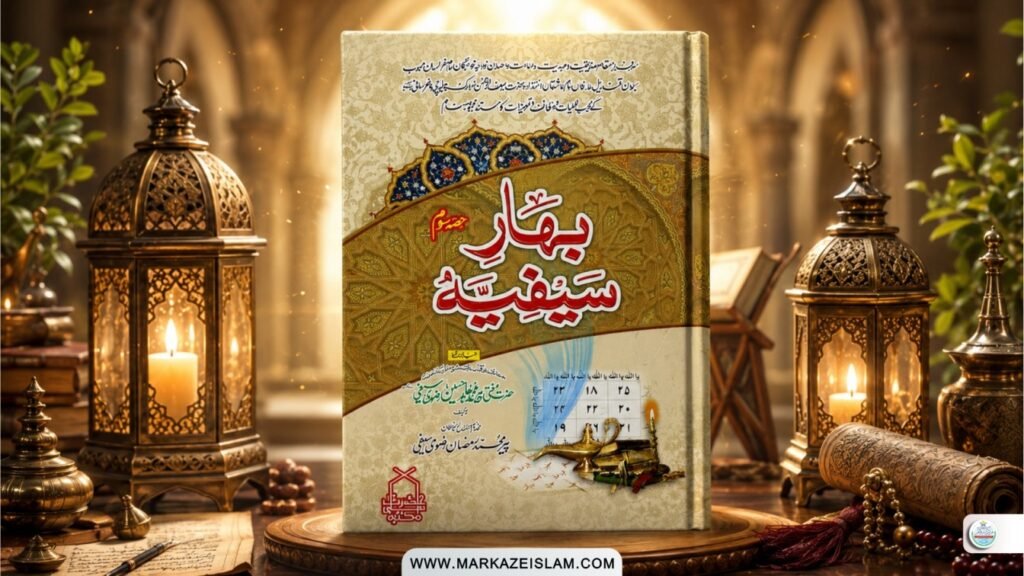
In this article we have described Salat al-Hajat and a few selected wazifas (devotional recitations). The practices and their detailed arrangement are given in the book “Bahar-e-Saifia” (Part Three). This book is a collection of the tried-and-tested (mujarrab) spiritual practices (amaliyat) and wazifas of Hazrat Saif-ur-Rahman Mubarak, compiled by Pir Muhammad Ramzan Rizvi Saifi.
This book is available only through Markaz-e-Islam, and it can now also be obtained online.
Order the book online → [Link]
• The Quran: al-Baqarah 2:45, 2:153, 2:186, 2:216; Ghafir 40:60
• Sunan al-Tirmidhi, hadith 479 (chain severely weak) and 3578 (al-Albani: sahih)
• Sunan Ibn Majah, hadith 1384 (chain severely weak) and 1385
• Sunan Abi Dawud, hadith 1319; Musnad Ahmad 23299 (al-Albani: hasan; some researchers: weak)
• al-Sunan al-Kubra of al-Nasa’i, hadith 10421
• Sahih Muslim, hadith 482 and 2735; Sahih al-Bukhari, hadith 6340
• al-Jarh wa al-Ta‘dil of Ibn Abi Hatim 7/84 (Fa’id ibn Abd al-Rahman)
• Ahmad Shakir, Takhrij Sunan al-Tirmidhi 2/344; al-Albani, Da‘if al-Targhib 416; Ibn al-Qayyim, Jala’ al-Afham
• Ibn al-Jawzi, al-Mawdu‘at; al-Zayla‘i, Nasb al-Raya (the twelve-rak‘ah narration)
• Ibn Hajar, Fath al-Bari 3/172
• Durr al-Mukhtar and Radd al-Muhtar, Bab al-Witr wa al-Nawafil; Fatawa Hindiyya